 Glyphfield
Glyphfield documentation
Learn how Glyphfield turns one brand identity into designs, motion and code, and find the guide for the Studio, the agent interfaces or the reference.
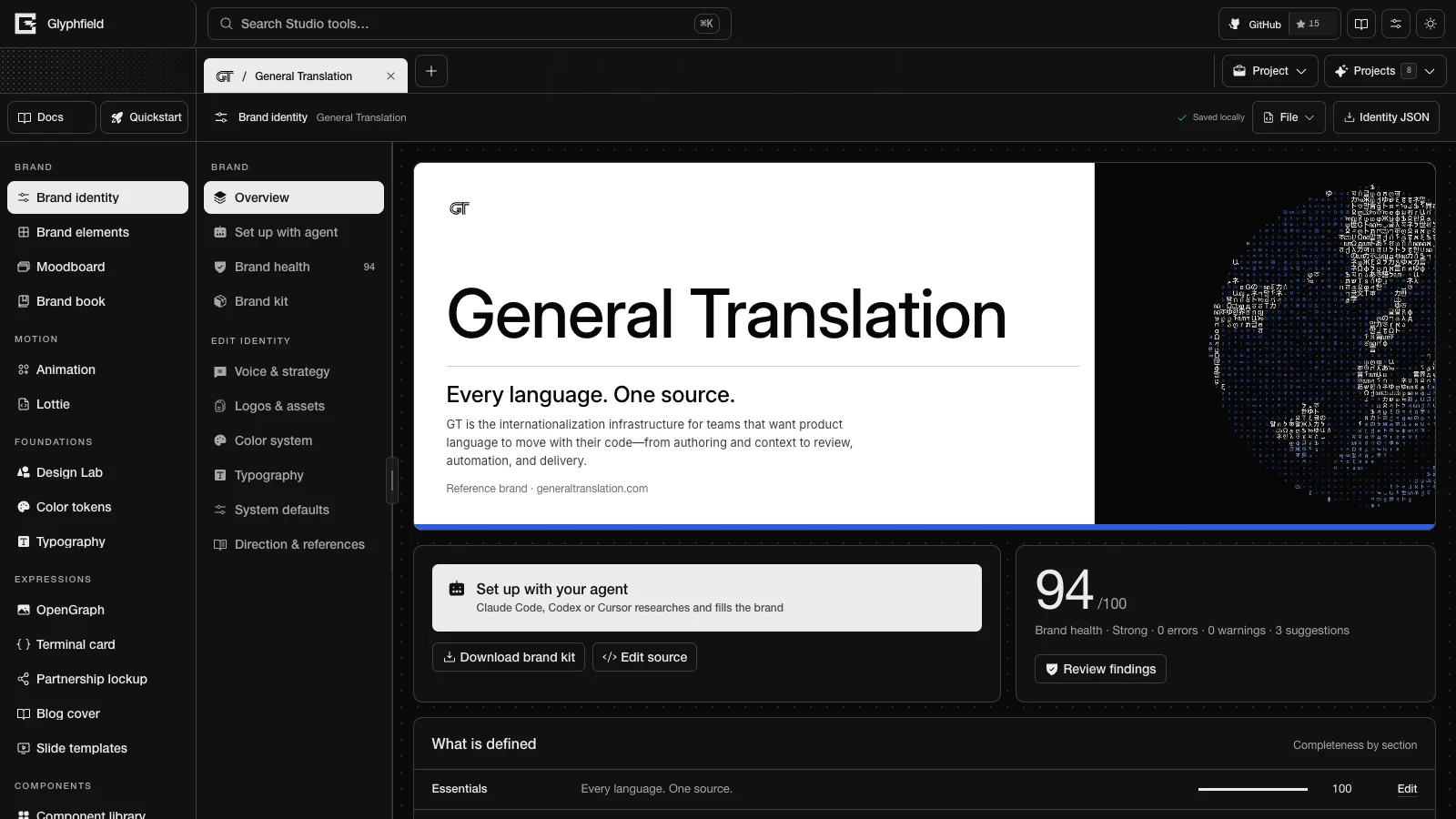
Glyphfield is a free, open-source brand design studio released under the MIT License. It runs in the browser and stores your work in that browser. A brand identity in Glyphfield is one record of a brand's strategy, voice, logos, colors, typography, pictures and layout rules. Every tool in the Studio reads that record, so a change to a color or a typeface appears in every design that uses it. The Studio is the visual workspace at /studio.
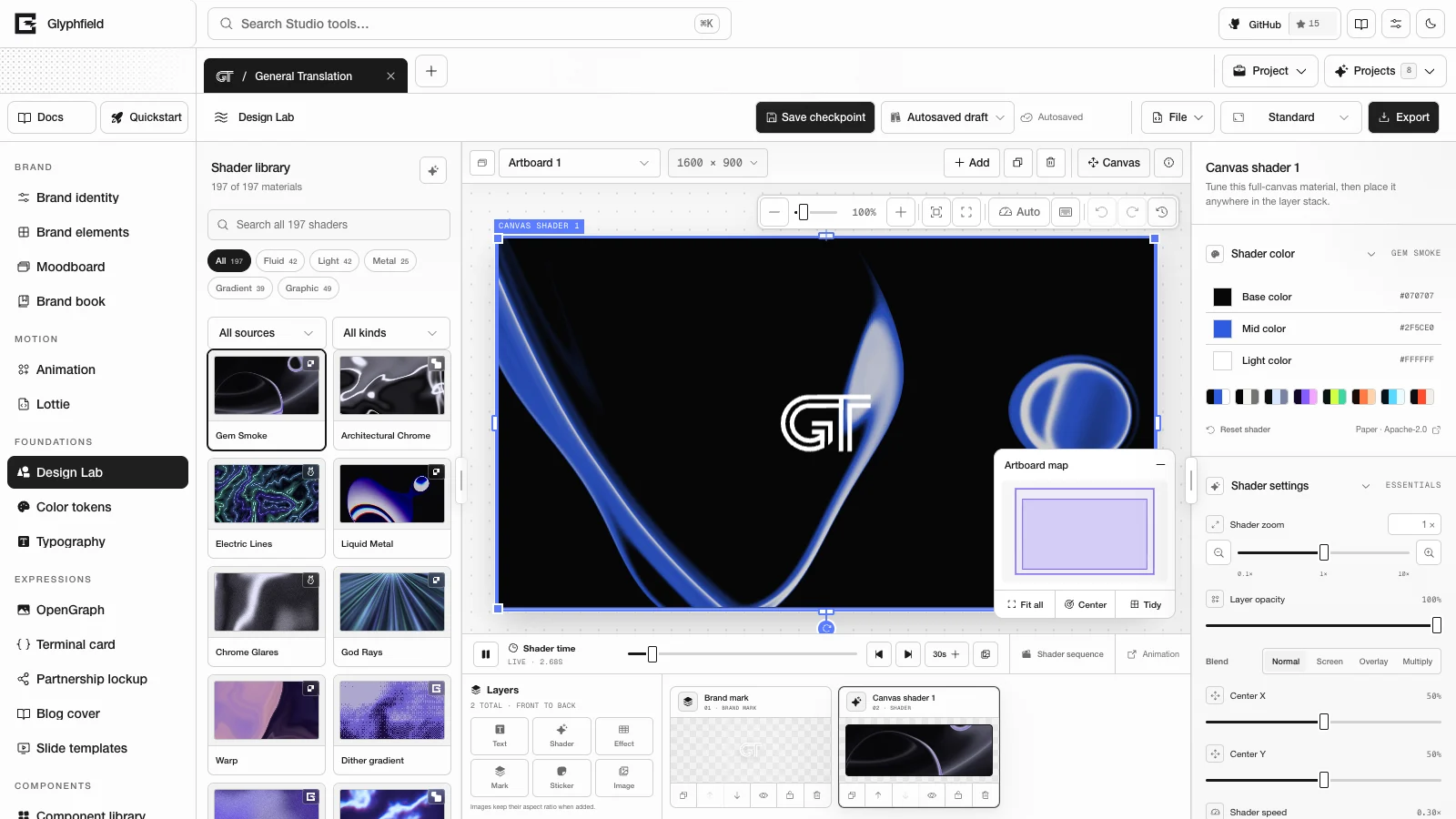
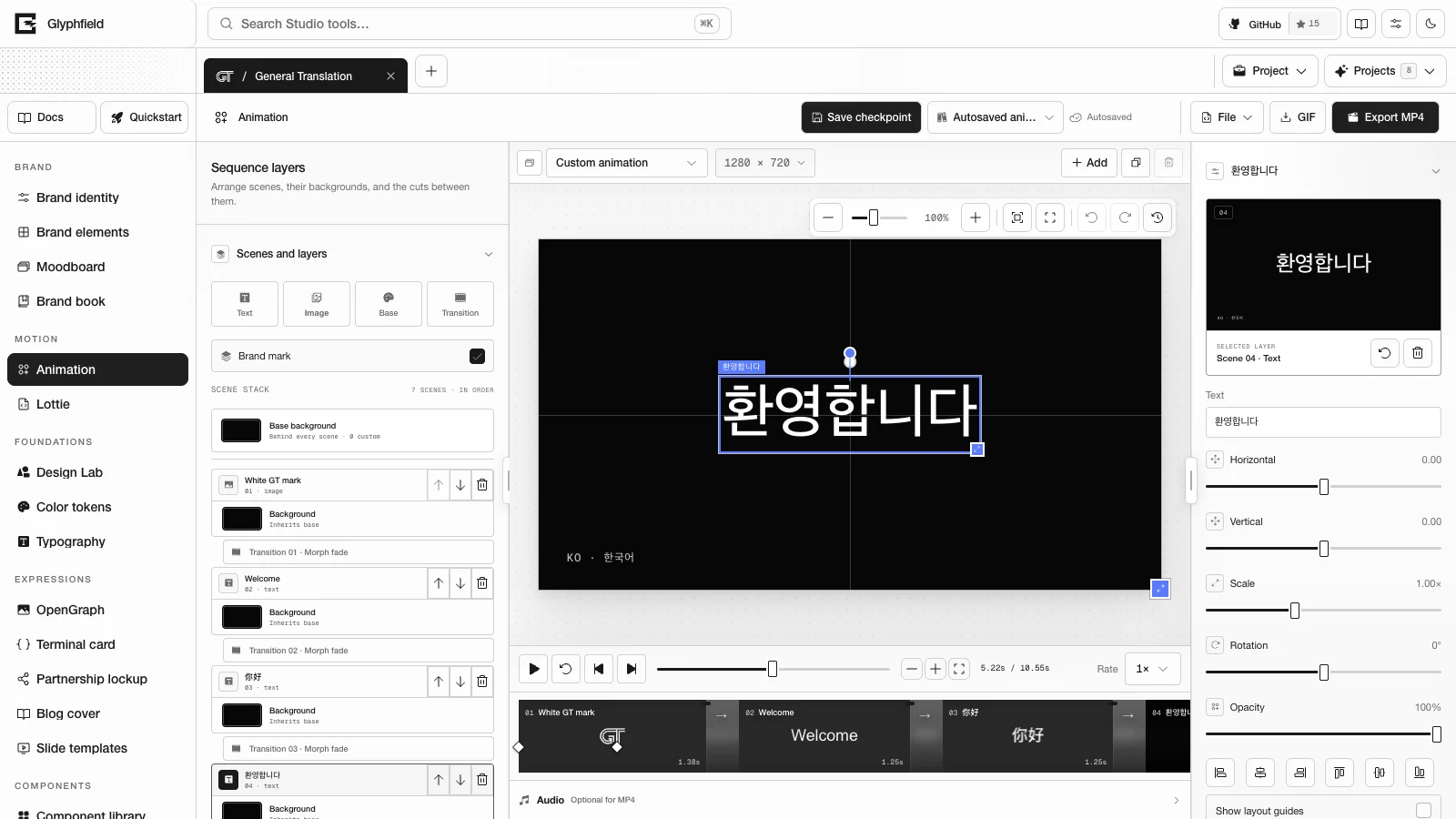
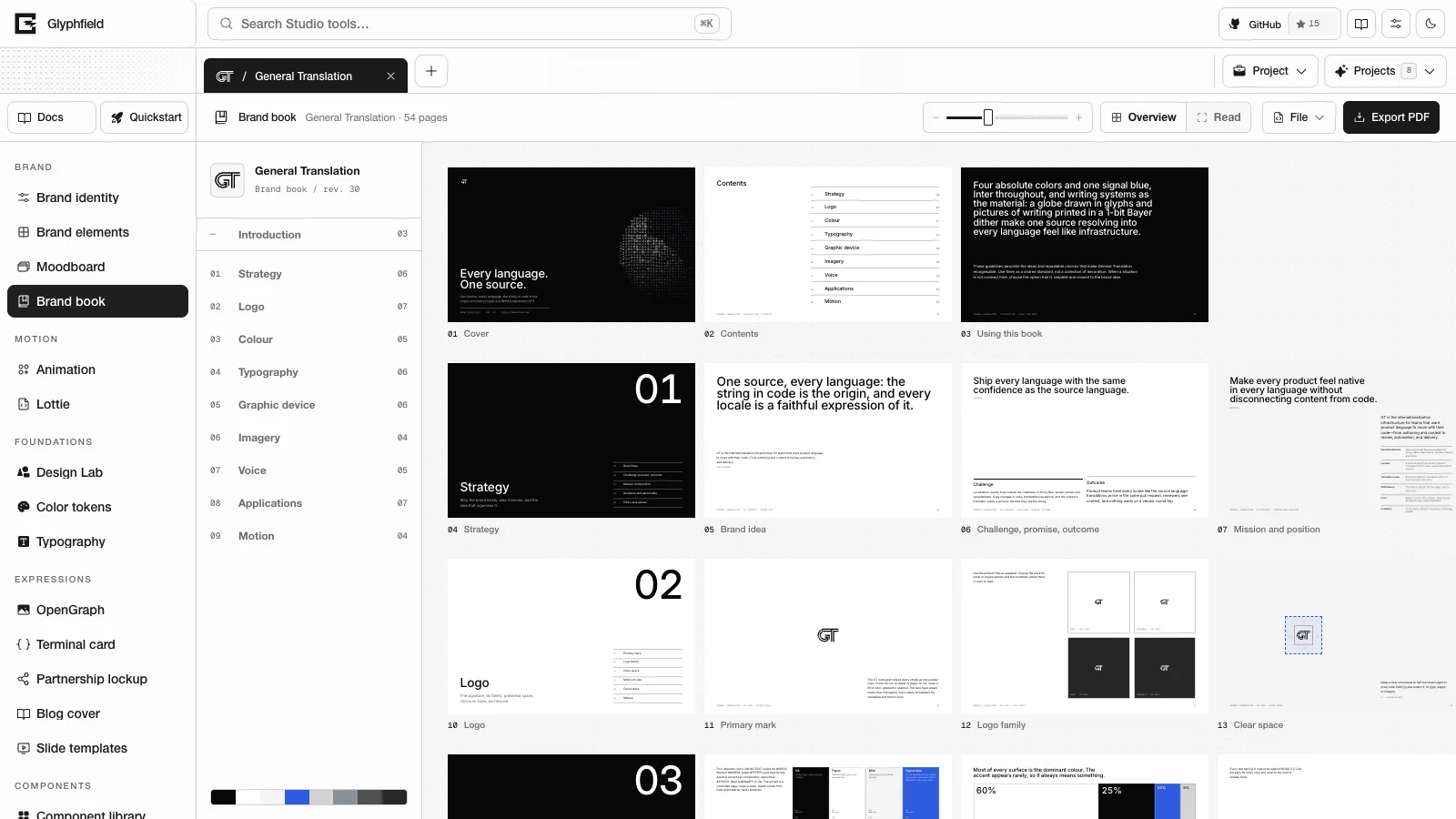
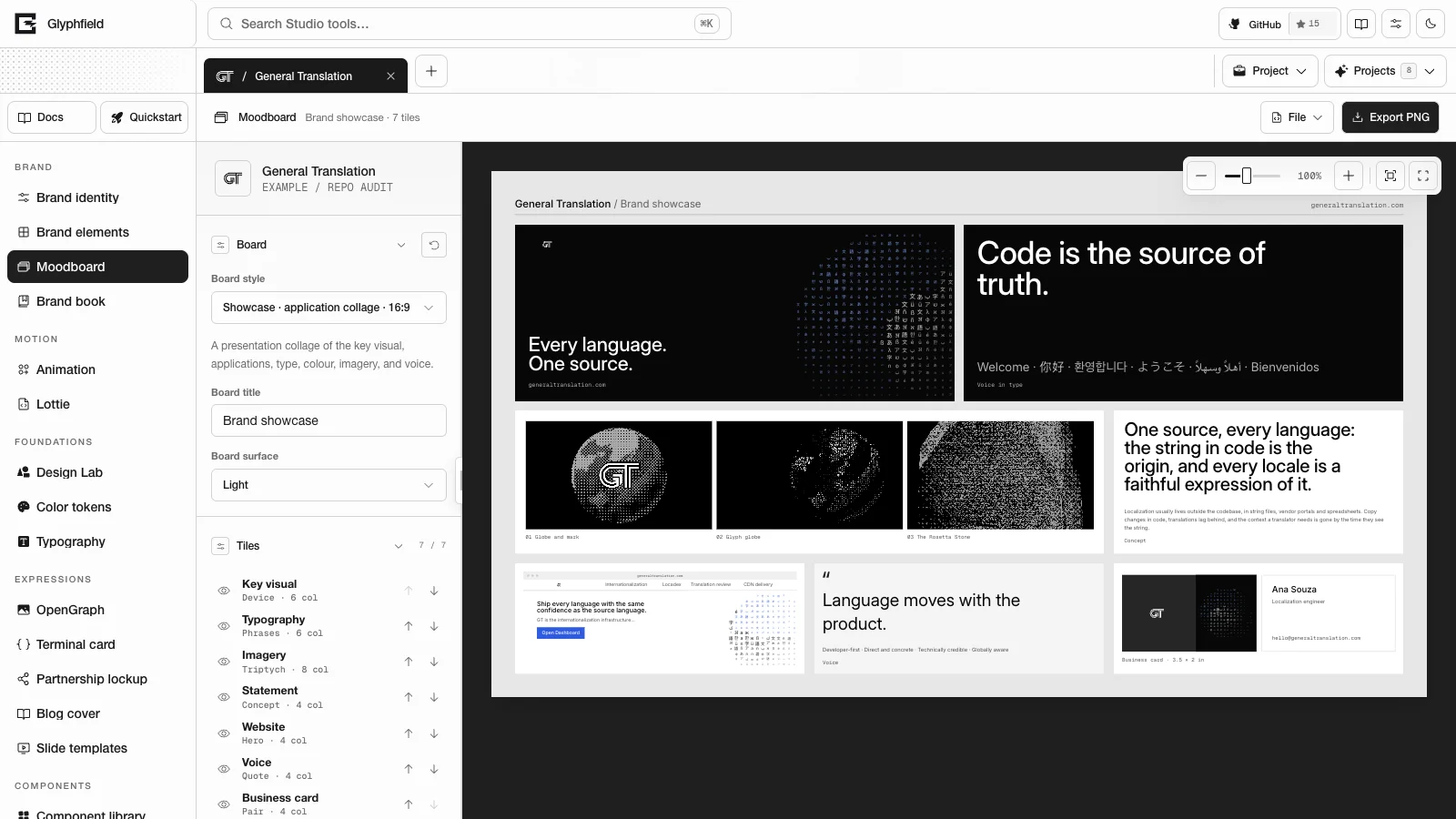
Studio tools cover brand applications, moodboards, a brand book, animation, Lottie files, layered compositions with live shaders, color and type tokens, social images, code cards, partner lockups, blog covers, slides and interface components. Each tool keeps its work as a JSON source document and exports files that the browser renders. Coding agents can operate the same tools through the Browser API (window.glyphfield.studio). They can also generate templates, backgrounds and briefs through an HTTP API that keeps no state between requests.
Starting points
Connected systems
The identity holds strategy, art direction, logos, licensed assets, colors, typography, voice, applications and system defaults.
Studio tools apply the identity to brand elements, moodboards, the brand book, Design Lab, Animation, Lottie, expression templates, tokens and components.
Each tool exposes its exact JSON source. Design Lab and Animation also keep saved checkpoints, autosave recovery and layer history.
Agents read versioned discovery routes, call deterministic HTTP generation, read processed Markdown and drive the Studio through the Browser API.
Studio screenshots
Agent interfaces
The visual Studio and the agent interfaces read the same catalogs and validators.
/api/agent,/api/catalog,/api/labs,/api/materials,/api/identitiesand/api/elementspublish the current capabilities.POST /api/generatevalidates and runs template, background, element-brief and Design Lab sequence requests./api/brand/validatechecks an identity, and/api/brand/kitrenders brand kit files.window.glyphfield.studiooperates the active Studio tool. It covers local files, exact source, Canvas, WebGL, GIF and MP4.- Every documentation page is available as processed Markdown at its URL with
.mdappended. Copy page at the top of each page copies that Markdown. The menu beside it offers View as Markdown, Open in GitHub, Open in ChatGPT, Open in Claude, Open in Cursor and Open in Scira AI. /llms.txtis a short guide for agents./llms-full.txtcontains the complete documentation as one text file.
An agent reads the discovery routes first and then chooses HTTP generation or the Browser API. It applies the smallest source change that does the job and checks browser-rendered work visually. It reports success only after it confirms that the returned or downloaded file is not empty.
Local storage
Projects, saved designs, uploaded files, fonts and drafts stay in the current browser profile. The HTTP API processes each request in memory and cannot read or change a project stored in a browser. The API rejects remote asset URLs.
Operations and contribution
Keep the identity, tool source, original assets and rendered proofs in files outside the browser.
Find whether a failure comes from source, storage, Canvas, WebGL, a codec or the download, without clearing the active project.
Serve the docs, discovery, generation, OpenGraph and Studio routes from your own deployment.
Update the catalog, state, source, Browser API, HTTP API, docs, exports and tests in one change.
- Back up and restore a project
- Troubleshoot the Studio and exports
- Check browser capabilities
- Self-host Glyphfield
- Review version compatibility
- Contribute to Glyphfield
- Licensing
Links
- Open the Studio
- Read the short agent guide
- Read the complete documentation as text
- Inspect the agent manifest
- Inspect the OpenAPI 3.1 document
- View the source on GitHub
Glyphfield's source code and original artwork are released under the MIT License. Bundled third-party marks, fonts, pictures and shader code keep their own licenses. Licensing lists each one and how to credit it.